
Oregon Coast · Oregon
Moving to Cannon Beach from California: The Honest Comparison (2026)
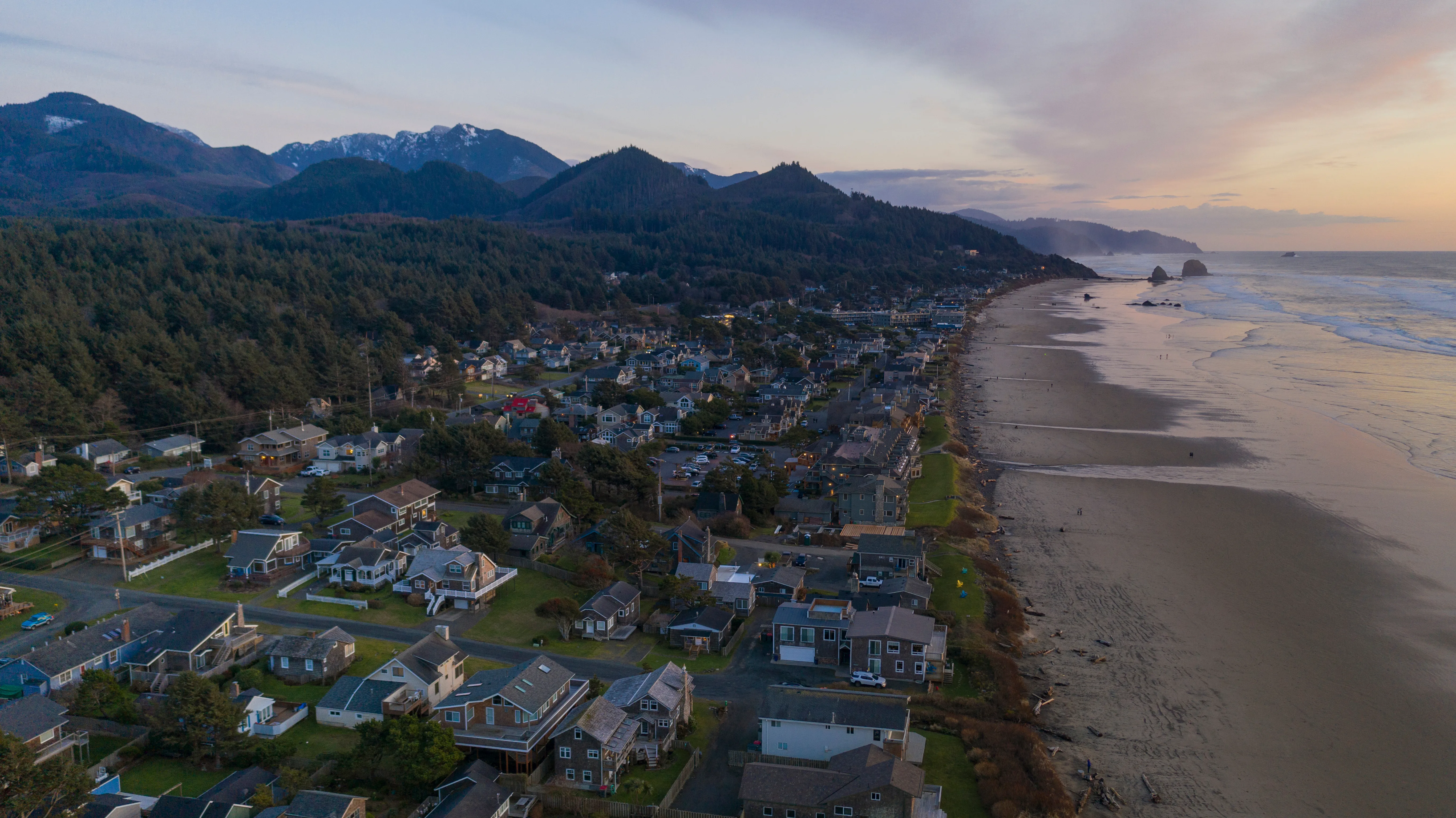
The Bay Area software engineer who finally went remote didn't move to Portland — he moved to the coast. The San Diego family who bought in Cannon Beach did it after one too many summers of $600 utility bills and wildfire smoke choking the air for weeks. The Sacramento buyer who sold her $480,000 townhome and walked into a fully detached house with an ocean view still tells people she didn't believe the math until she closed escrow. California-to-Oregon migration has been a steady drumbeat for years, but the Cannon Beach version of that story is distinct: this is a move toward something specific — a small, unhurried beach town with one of the most recognizable shorelines on the West Coast, a community of under 1,500 year-round residents, and a pace of life that has essentially no California equivalent.
The hard part deserves naming upfront. Cannon Beach gets approximately 185 days of precipitation per year and logs only 124 sunny days annually — compared to the 260-plus days of sun that San Francisco buyers are used to, and the near-constant sunshine that San Diego and LA buyers take entirely for granted. Winter here is gray, damp, and long. The social scene is thinner than any California city you've likely lived in, the restaurant options are seasonal, and the nearest urban center with a hospital system is Astoria, about 25 miles north. If you're expecting California beach life with an Oregon zip code, this guide exists specifically to correct that expectation before you make an offer.
What this guide covers: a direct cost comparison broken down by where in California you're coming from, a clear-eyed look at what the tax picture actually changes, what your California equity realistically buys in each price tier, and an honest account of what transplants say after a year. There's also an interactive comparison tool so you can look up your specific California city's housing costs against Cannon Beach's current market.

| Cannon Beach, OR | Bay Area | Southern CA | Sacramento Metro | Central Valley | |
|---|---|---|---|---|---|
| Median Home Price (approx. 2026) | $915,000 | $1,300,000–$1,800,000 | $750,000–$1,100,000 | $480,000–$600,000 | $320,000–$420,000 |
| Property Tax Rate (effective) | 0.52% | 1.1%–1.25% | 1.05%–1.2% | 1.0%–1.15% | 1.0%–1.1% |
| State Income Tax (top bracket) | 9.9% | 13.3% | 13.3% | 13.3% | 13.3% |
| State Sales Tax | 0% | 7.25%–10.25% | 7.25%–10.75% | 7.25%–8.75% | 7.25%–8.25% |
| Avg Utilities (monthly est.) | $150–$180 | $230–$310 | $200–$290 | $200–$270 | $190–$250 |
| Avg 1BR Rent | $1,400–$1,800 | $2,800–$3,800 | $2,200–$3,200 | $1,500–$2,000 | $1,000–$1,400 |
A Bay Area buyer selling a $1.5 million Walnut Creek home and purchasing in Cannon Beach at the current median is either eliminating their mortgage entirely or carrying a very small one — and dropping from a Contra Costa County effective property tax rate above 1.1% down to 0.52%. On a $915,000 home, that difference in annual property taxes alone runs over $5,000 per year. Compounded over ten years with Measure 50's 3%-per-year assessed value cap protecting Oregon long-term owners, the savings are structural, not superficial.
The sales tax shift is the one California transplants feel fastest. At California's statewide minimum of 7.25% — and closer to 10.5% in Santa Clara County or Los Angeles — a household spending $60,000 annually on taxable goods and services is paying $4,350 to $6,300 in sales tax that simply disappears in Oregon. That figure doesn't show up on a mortgage payment, but it shows up in the monthly reality of living here.
Oregon does levy a state income tax, and any California buyer who walks in assuming otherwise is heading for a surprise. The graduated rate tops out at 9.9% — lower than California's 13.3% top bracket, but not zero. For a household earning $150,000, Oregon's effective state income tax rate runs roughly 8–9%, compared to approximately 9.3–10% in California at the same income level. The gap is real but narrower than many California transplants expect.
| Tax Item | California | Oregon | Net Impact |
|---|---|---|---|
| State Income Tax (top bracket) | 13.3% | 9.9% | Oregon saves ~$3,000–$5,000/yr at $150K income |
| State Sales Tax | 7.25%–10.75% | 0% | Oregon saves $4,000–$6,000+/yr for avg household |
| Effective Property Tax (on $915K home) | ~$9,800–$11,400/yr | ~$4,758/yr | Oregon saves ~$5,000–$6,600/yr |
| Capital Gains Tax | Up to 13.3% state | Up to 9.9% state | Oregon advantage |
| Senior Property Tax Deferral (62+) | Limited | Available in Oregon | Benefit for retirees |
Oregon's Measure 50 is the tax mechanism most California buyers don't know about until their agent mentions it. Assessed values are capped at 3% annual increases after purchase, which means a Cannon Beach home bought in 2026 won't have its property tax base explode with the market the way California properties periodically do in post-Prop 13 reassessment scenarios. For buyers planning to hold long-term — and most Cannon Beach buyers are — this is a meaningful structural advantage. Oregon also offers a senior property tax deferral program for residents 62 and older, which allows qualifying homeowners to defer property taxes until the property is sold.
A California household earning $150,000 moving to Oregon shifts from California's effective state rate of roughly 9.3% to Oregon's roughly 8.5–8.8% effective rate. That saves somewhere in the range of $750–$1,200 per year on income tax. Add back the sales tax savings and the property tax differential, and the total annual household tax reduction for a median Cannon Beach buyer coming from the Bay Area runs $8,000–$12,000 per year — a number worth factoring into any long-term financial plan.
A buyer selling a Cupertino or San Jose home in the $1.6–$1.8 million range and relocating to Cannon Beach is arriving with enough equity to close all-cash on even the upper tier of the Cannon Beach market. The Haystack Heights neighborhood, where lots slope upward with filtered or direct ocean views, regularly sees listings in the $1.1–$1.5 million range for well-built single-family homes. West Presidential Streets — the corridor west of the main town grid closest to the beach — is where ocean-view and beachfront properties sit, and those run $1.2 million and above, sometimes well above for direct frontage.
Bay Area buyers in this equity tier are genuinely in a different position than buyers from any other California market: they're not choosing between Cannon Beach properties, they're choosing how much of their equity to deploy and how much to keep liquid. The buyer who sold in Walnut Creek for $1.45 million and buys a $950,000 property in Cannon Beach keeps nearly $500,000 in cash after the transaction — and carries a 0.52% annual property tax load instead of Contra Costa County's 1.1%+. That downstream liquidity changes retirement planning, investment options, and monthly cash flow in ways that take time to fully absorb.
A buyer leaving Irvine or Pasadena with $900,000 in net equity is positioned to purchase comfortably at or above Cannon Beach's median. The Tolovana Park neighborhood, at the southern end of town near Tolovana Beach State Recreation Site, offers solid value for this price range — homes here tend to run $800,000–$1.1 million, with a quieter residential character than downtown and direct access to one of the more uncrowded stretches of beach in the area.
The South Cannon Beach and Ecola Creek neighborhoods also serve Southern California buyers well at this equity tier. These areas are less tourist-saturated than downtown or North End, and they represent the kind of stable, owner-occupied residential character that buyers leaving San Diego or the South Bay are often looking for. At $900,000 in equity and a target purchase in the $850,000–$950,000 range, a buyer from Long Beach or Torrance arrives with the ability to put 20–30% down without straining their reserves.
This equity range is where the math gets more nuanced but the move still makes compelling financial sense. A buyer who sold a Sacramento home at $520,000 and cleared $430,000 after commissions and closing costs is arriving with a strong down payment — roughly 45–50% down on a $950,000 purchase — but will still carry a meaningful mortgage. The appeal isn't a mortgage-free situation; it's the structural shift to zero sales tax, a sub-1% property tax rate, and a coastal lifestyle their Sacramento income couldn't access at home.
Midtown Cannon Beach and East Presidential Streets represent the most practical targets for this equity tier. East Presidential Streets sit on the inland side of the main north-south corridor and offer more modest pricing than their west-facing counterparts — entry points in the $700,000–$850,000 range exist here for buyers who are patient. A buyer from Elk Grove or Roseville at this equity level is buying meaningfully more per square foot than they left, paying less in property taxes annually, and eliminating sales tax on every transaction going forward.
Buyers coming from Fresno, Stockton, or Modesto are working with the narrowest relative advantage, but the comparison still holds on the tax side. With $350,000–$400,000 in equity and a need to finance a significant portion of a $900,000+ purchase, the monthly payment math requires careful underwriting. The most honest advice for Central Valley buyers: look seriously at Arch Cape, immediately south of Cannon Beach, or at the easternmost residential streets of Cannon Beach where pricing can dip below $800,000 for smaller homes.
The lifestyle gain — moving from a hot, landlocked agricultural city to a temperate Oregon Coast town — is as dramatic as any transition in this guide. The financial gain is real but smaller in absolute terms. This is a buyer who benefits most from a detailed mortgage scenario model before making an offer, and for whom the Sacramento-area OHCS down payment assistance programs would no longer apply once above certain price thresholds.

Looking to buy in Cannon Beach? Estimate your payment.
Enter your numbers to see an estimated monthly mortgage payment.
Estimate only. Excludes HOA fees and mortgage insurance.
Nobody who's lived in Cannon Beach for three years will tell you the weather is easy. With roughly 92–94 inches of rainfall annually and only 124 sunny days a year, this is a fundamentally different climate than any California city. Los Angeles averages somewhere around 284 sunny days per year; San Diego is comparable. Even San Francisco — which Bay Area residents often describe as cold and foggy — logs 260 sunny days annually, twice what Cannon Beach sees. November is the rainiest month here, averaging 23 wet days. December brings just 2.1 average daily sunshine hours. This isn't a detail in fine print — it's the central physical reality of life on the north Oregon Coast.
What California transplants consistently say they love after a year: summer. July in Cannon Beach — 8 rainy days for the entire month, an average high of around 65°F, the kind of cool, clean beach days that San Diego beach crowds never allow — is legitimately spectacular and genuinely uncrowded by comparison to any California coastal town. The Sandcastle Festival in late June, the Stormy Weather Arts Festival in November, and the low-key rhythm of Hemlock Street in the shoulder seasons create a community calendar that feels intimate rather than performed. Haystack Rock at low tide on a Tuesday morning in August, with maybe thirty people on the beach, is something no California coastal city can offer.
What they miss is honest: the food scene. Cannon Beach has good restaurants, but it's a seasonal, small-town food scene — not the year-round density of San Jose's Santana Row or San Diego's Little Italy. They miss the social infrastructure of larger California cities — the gyms, the coffee shop density, the weekend farmer's market with 200 vendors. They miss driving to a beach in January that doesn't require rain gear. And a meaningful number of California transplants who move specifically for the outdoor lifestyle find that the Oregon Coast winter requires a real psychological recalibration — what outdoor life looks like from October through March is a different activity set than California trained them for.
If you want to see how Cannon Beach compares directly to the city you're leaving, use the tool below — it covers the 120 largest California cities with current housing and tax data.
Home prices: Redfin median sale data, Q1–Q2 2026. Select your city to compare.
Ready to talk through what your specific California equity could do in Cannon Beach? Todd can model your exact scenario in a single call.
Assuming the whole town is uniform. Cannon Beach covers 1.8 square miles of land area, but the character differences between neighborhoods are real and consequential. The North End near Ecola State Park access is quieter and more residential; downtown and Hemlock Street are heavily tourist-trafficked in summer and require a tolerance for foot traffic and seasonal noise. West Presidential Streets have ocean-facing lots that command a premium price and a premium wind exposure. Buyers who don't walk every neighborhood before making an offer often discover these differences after closing.
Not accounting for flood risk. Redfin's hazard assessment flags Cannon Beach with a "Major" Flood Factor — a meaningful data point for a buyer coming from a California neighborhood that hasn't seen a flood event in a generation. Properties near Ecola Creek and lower-lying areas carry higher flood insurance requirements. This is not a reason to avoid the market, but it is a line item to build into your cost model before you're surprised at closing.
Underestimating the winter commute reality. US-101 through the Coast Range, including the Nehalem Bay stretch and the Arch Cape tunnel section, can be hazardous in winter weather. Buyers who plan to commute to Portland — 90 minutes in good conditions — should understand that winter makes that trip longer, less predictable, and occasionally closed by slides. This is a remote-worker market for a reason. If your job requires physical presence in Portland more than twice a week, run the logistics very carefully.
Projecting a California outdoor lifestyle onto a Cannon Beach winter. California coastal living in winter means lighter jackets and continued outdoor activity. Cannon Beach in January means waterproof everything, whale watching from the bluff rather than the beach, and rebuilding an outdoor routine around different conditions. Transplants who arrive with this expectation calibrated correctly tend to fall deeply in love with the place. Those who arrive expecting California-style year-round beach access are the ones who end up back in California within two years.
Bay Area sellers arriving with $1.2 million or more in equity are often all-cash buyers or operating at loan-to-value ratios below 30%. At that LTV in a small coastal market, rate matters less than speed and certainty of close. A clean all-cash offer in Cannon Beach can close in 14 days and will typically beat a financed offer even at a slightly lower price. For Bay Area buyers who owned investment properties — a rental in Oakland or a second home in Tahoe — the 1031 exchange option deserves a conversation before you sell: you can defer federal and state capital gains taxes by rolling equity directly into a Cannon Beach purchase. The 1031 Tax-Deferred Exchange in Cannon Beach post in this series covers the mechanics in detail.
Southern California sellers coming in with $700,000–$1.0 million in equity are typically looking at conventional financing in the $200,000–$400,000 range to reach Cannon Beach's median. Most Cannon Beach transactions fall below the current conforming jumbo threshold, meaning standard conventional underwriting applies without the added scrutiny of a jumbo loan. Buyers leaving San Diego or Orange County with a 20–25% down payment on a $900,000 home are in a strong qualifying position and should expect straightforward conventional approval timelines.
Sacramento and Inland Empire buyers buying below $800,000 in Cannon Beach or its immediate coastal neighbors may find Oregon-specific programs helpful. Oregon Housing and Community Services (OHCS) offers down payment assistance and rate reduction programs for first-time buyers and qualifying income levels, though the price caps on some programs can be limiting at Cannon Beach's current prices. Todd can walk through what applies to your specific purchase price and income in a single conversation.
Local Expert Takeaway: California buyers consistently underestimate how thin Cannon Beach's inventory actually is. With only about 1,888 total housing units in a 1.8-square-mile city — and roughly 63% of those sitting empty or seasonally occupied — the pool of homes genuinely for sale at any given time is small. When a well-priced home hits Hemlock Street corridor or Tolovana Park, it moves. Get your financing squared away before you start touring, get a local agent who knows which sellers are motivated versus just testing the market, and don't let a first lowball offer cost you a property you actually want. The buyers who close in Cannon Beach move with intention, not hesitation.
✅ The tax picture genuinely improves for most California households — the combination of no sales tax, a sub-1% property tax rate, and a lower top income tax bracket typically saves $8,000–$12,000 per year for a median Bay Area buyer at Cannon Beach's current median price.
⚠️ The weather is not a minor footnote — 185 precipitation days per year and just 124 sunny days is a fundamental lifestyle shift from any California origin market. Plan for it specifically, not vaguely.
📍 Your California equity tier determines your neighborhood options — Bay Area equity buys ocean-view in West Presidential Streets or Haystack Heights outright; Sacramento equity lands you in Midtown or East Presidential Streets with a mortgage worth carrying; Central Valley buyers should run the numbers on Arch Cape as a closely adjacent alternative before committing to Cannon Beach proper.
Is moving from California to Cannon Beach worth it?
For remote workers, retirees, and buyers who genuinely want small-town coastal life — and have prepared honestly for the weather — the answer is typically yes. The tax savings are structural and compound over time, the property appreciates in a supply-constrained market, and the quality of life in summer and shoulder seasons is something no California coastal city at comparable pricing can deliver. The buyers for whom it doesn't work are those who underestimate how different winter is here and how much they relied on California's urban infrastructure in ways they didn't realize.
How much cheaper is housing in Cannon Beach vs. California?
Cannon Beach's current median sold price sits around $915,000 — which sounds high until you compare it to the Bay Area's $1.3–$1.8 million range or even San Diego's $750,000–$1.1 million market. The price gap relative to Bay Area metros is significant; relative to Sacramento or Inland Empire, Cannon Beach is actually more expensive per square foot but dramatically lower in annual carrying costs due to Oregon's 0.52% effective property tax rate. The honest answer: Cannon Beach costs less than most of the Bay Area and coastal Southern California, more than inland California, and represents strong long-term value in a supply-constrained coastal market.
What do I need to know about moving from California to Oregon?
Oregon has a state income tax — that surprises buyers who assumed the Pacific Northwest was tax-free. The income tax tops out at 9.9%, lower than California's 13.3% but not zero. What Oregon doesn't have is a sales tax, which saves most households thousands annually. Oregon also has Measure 50, which caps assessed value increases at 3% per year, protecting long-term owners from runaway property tax bills. On the practical side: build radon testing into your home inspection budget, understand flood zone designations before making an offer on coastal properties, and get clear on your tolerance for gray winters before you commit — it's the single most predictive factor in whether California-to-Oregon Coast moves stick long term.
Explore the full Cannon Beach series: The Ultimate Cannon Beach Relocation Guide · Is Cannon Beach Safe? · Cost of Living in Cannon Beach · Best Neighborhoods in Cannon Beach · Cannon Beach Schools & Family Life · Cannon Beach Youth Sports · Cannon Beach Parks & Recreation · Retiring in Cannon Beach · 1031 Tax-Deferred Exchange in Cannon Beach · Cannon Beach First-Time Homebuyers Guide · · Moving to Cannon Beach from California
Tell us what you need help with and we'll connect you with local resources.

About the Author
Todd Davidson is the founder of Living in Oregon and Living in Washington, where he publishes in-depth city guides, neighborhood resources, and local market insights covering more than 180 communities across the Pacific Northwest. While his background is in home financing and real estate, he created these digital platforms to help families research and compare regions before making a move.
Check Out the Oregon Coast Rankings: Oregon Coast Cost of Living — All 16 Cities Ranked · Best Places to Retire on the Oregon Coast · Best Oregon Coast Cities for Families · Best Oregon Coast Cities for Remote Workers · Oregon Coast Real Estate Market Report 2026 · Oregon Coast vs. Washington Coast