
Southern Oregon · Oregon
Is Ashland Safe? Crime Rates, Safest Neighborhoods & Local Reality (2026)
Ashland has a reputation that runs ahead of its reality. The Oregon Shakespeare Festival, Lithia Park, and Southern Oregon University paint a picture of a cultivated, low-key college town where the biggest danger is getting caught in festival traffic on a summer afternoon. That picture isn't wrong — but it's incomplete. The safety story here is more nuanced than the brochure version, and buyers who don't understand it tend to make neighborhood decisions based on aesthetics rather than actual risk patterns.
What the numbers reveal is a city with a split personality. Violent crime in Ashland runs meaningfully lower than national averages — a 1-in-381 chance of becoming a victim in any given year is genuinely reassuring for most households. Property crime is the real story, running above the national average and concentrated in predictable, geography-specific clusters. Understanding which parts of the city generate those numbers — and why — changes how you evaluate a home near the plaza versus one off Oak Knoll Road.
This guide cuts through the methodology wars between crime-rating sites (they disagree significantly on Ashland, and there's a real reason for that) and gives you the street-level picture that safety scores alone can't provide. By the end, you'll know exactly which neighborhoods carry the most practical risk for daily life, which are genuinely calm, and what locals do — not worry — to live comfortably here.

The first thing to understand about Ashland's crime data is that different platforms grade it very differently — and both are technically correct. Local police data and FBI reporting for 2024 suggest violent crime runs around 3.6 per 1,000 residents, which is lower than the Oregon state average and roughly in line with the national average for cities of similar size. On that metric alone, Ashland looks like the safe college town you'd expect. Property crime, at approximately 18 per 1,000 residents, tells a different story — that figure sits above the national average and accounts for why some aggregate safety scores drag Ashland into surprising percentile rankings.
The discrepancy between a 2022 Safewise "top 20 safest Oregon cities" designation and current aggregate grades that rank Ashland less favorably isn't a contradiction — it reflects different methodologies and different time periods. Violent crime in Ashland has increased modestly in recent years (40 violent crimes were reported in 2024, up from 29 the prior year), while property crime has trended downward over the same stretch. The net result is a city that has gotten slightly more complicated on the violent side while improving where most residents actually felt the pinch.
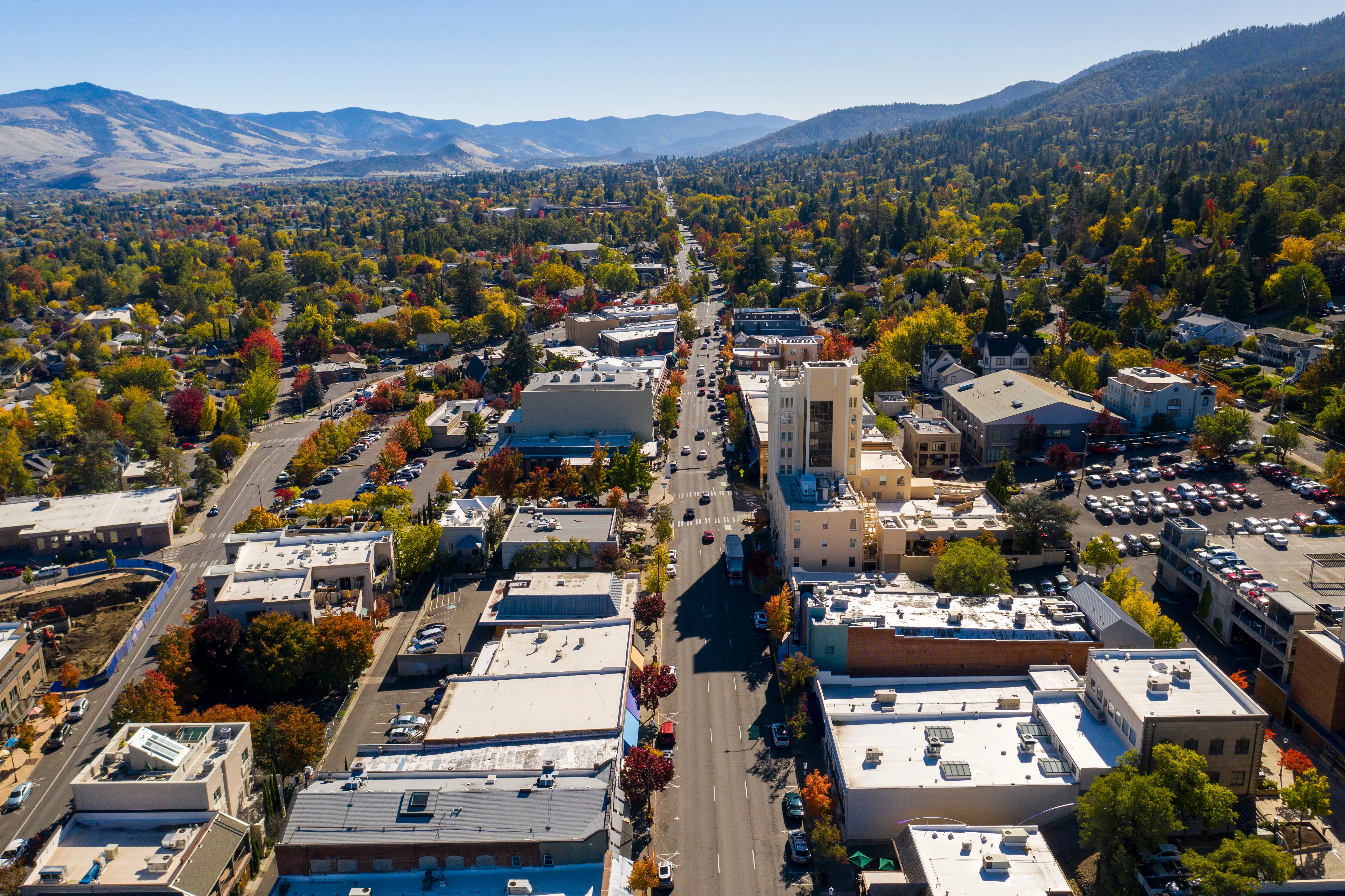
What drives these numbers structurally is worth understanding. Ashland draws roughly 400,000 visitors a year to the Oregon Shakespeare Festival and Lithia Park, which means a significant share of crimes — particularly property crimes — occur in dense commercial and tourism corridors where neither the victim nor the offender actually lives here. The northwest retail corridor and the downtown plaza concentrate foot traffic, commercial activity, and the majority of incidents. The residential neighborhoods south and east of downtown tell a substantially quieter story.
Locally reported data suggests Ashland's violent crime rate sits around 3.6 per 1,000 residents annually — a number that places it lower than the Oregon statewide average and competitive with national benchmarks for cities of its size. In practical terms, this means that for the vast majority of Ashland residents, violent crime is a background concern rather than a daily reality. The incidents that do occur tend to cluster around the downtown core and the Ashland Street corridor — areas where transient populations, late-night activity, and concentrated foot traffic create the conditions for elevated risk. Residential neighborhoods, particularly those south of Siskiyou Boulevard and east of the freeway, rarely see these types of incidents.
Property crime is where Ashland buyers need to pay attention. The rate — commonly reported around 18 per 1,000 residents — runs above the national average, with larceny and vehicle-related theft accounting for the bulk of incidents. It concentrates visibly along Oregon Route 99 (Ashland Street) and the downtown plaza area, where retail density and tourist traffic create opportunity. The city has responded by establishing two Enhanced Law Enforcement Area (ELEA) zones under Concentrated Area Patrol: one covering downtown Ashland (active since 2012) and a newer one along the Ashland Street business corridor, added in January 2025. Outside these zones, property crime drops considerably — the southern residential neighborhoods, for instance, see roughly half the victimization rate of the western commercial areas.
The Railroad District sits in Central Ashland adjacent to the downtown core, which puts it close to where both foot traffic and property crime concentrate. The historic Craftsman bungalows along A Street and B Street are genuinely appealing, and the neighborhood has a real community character — but buyers should know that proximity to the downtown Enhanced Law Enforcement Area means this corridor sees more incidents than the residential numbers alone would suggest. Locals here tend to use motion-sensor lighting, lock vehicles consistently, and don't leave valuables visible in cars. Best for: Buyers who want walkable access to the plaza and accept the trade-off of a more active urban environment.
Oak Knoll is among the more objectively calm neighborhoods in Ashland, earning a crime score of 3 out of 10 — lower numbers meaning lower risk — and outperforming both city and national averages on safety metrics. The neighborhood sits southeast of downtown, buffered from the commercial corridors that generate most of Ashland's property crime. Homes here on and around Oak Knoll Road are predominantly owner-occupied, which consistently correlates with lower crime rates citywide. Best for: Families and retirees who want a measurably safer residential environment with easy access to Highway 66 and quick freeway access south.
Northwest Ashland contains more retail infrastructure than the residential neighborhoods to the south and east, which matters for the crime picture. The research is clear that commercial density — more storefronts, more parking lots, more foot traffic — produces higher property crime counts regardless of the underlying residential character. This area is perfectly livable, but buyers targeting it should understand that the victimization rates here run closer to 1 in 18 for the western portions of the city compared to 1 in 35 in the south. Best for: Buyers who prioritize retail convenience and can live with slightly elevated property crime numbers as the practical cost.
The area surrounding Southern Oregon University carries the predictable safety profile of most college-adjacent neighborhoods — generally low on serious violent crime, occasionally elevated on minor property incidents like bike theft, package theft, and vandalism. The student population cycles through frequently, which means fewer long-term owner-occupants anchoring the blocks immediately around campus. The closer you get to the SOU campus along Indiana Street and Siskiyou Boulevard, the more that pattern holds; move a few blocks in either direction and the neighborhood settles considerably. Best for: Buyers comfortable with a college-town rhythm who value walkability to campus facilities and don't need the quietest possible residential environment.
South Ashland is where locals who've thought carefully about this tend to end up. The southern portions of the city consistently show the lowest victimization rates in available neighborhood-level data — roughly 1 in 35 for overall crime — compared to the western commercial zones. The housing stock here is generally newer, the population more consistently owner-occupied, and the distance from the downtown tourist corridor provides a natural buffer from the property crime activity that drives Ashland's aggregate numbers. Best for: Buyers who want the lowest practical risk profile within city limits combined with straightforward access to I-5.
Central Ashland sees the highest raw crime counts of any part of the city — approximately 527 incidents per year in the central core — but that figure needs context. Much of it originates in the commercial blocks and tourist-heavy areas rather than in the residential neighborhoods immediately surrounding them. The "above the boulevard" versus "below the boulevard" distinction locals use refers to Oregon Route 99 (Siskiyou Boulevard) as the dividing line, and it matters for daily experience. Central blocks below the boulevard, close to the plaza and East Main, run hotter than the quieter residential streets above it. Best for: Buyers who understand the geography and specifically target blocks removed from the commercial core.
| City | Violent Crime/1K | Property Crime/1K | Overall Safety Profile |
|---|---|---|---|
| Ashland | ~3.6 | ~18 | Mixed — low violent crime, above-average property crime |
| Medford | ~5.8 | ~38 | Higher across both categories; largest city in the region |
| Jacksonville | ~1.2 | ~8 | Notably lower; small population, limited commercial density |
| Talent | ~4.1 | ~22 | Similar violent crime profile; fewer tourism-driven property incidents |
| Phoenix | ~4.8 | ~26 | Slightly elevated across both; recovering from 2020 Almeda Fire impacts |
| Central Point | ~3.9 | ~24 | Comparable to Ashland; suburban retail corridors drive property numbers |
The regional context matters here. Ashland's property crime rate, while above the national average, runs well below Medford's — the urban center 15 minutes north where commercial density and population create a substantially higher baseline. Jacksonville, with its tiny population and almost no retail infrastructure, sits at the other end of the spectrum. For buyers choosing between Ashland and its immediate neighbors, the honest comparison is that Ashland is meaningfully safer than Medford and the larger Jackson County cities while carrying more property crime than the small rural communities surrounding it.
Looking to buy in Ashland? Estimate your payment.
Enter your numbers to see an estimated monthly mortgage payment.
Estimate only. Excludes HOA fees and mortgage insurance.
The safety apps and aggregate scores miss something important about Ashland: a significant portion of what registers as "crime" in this city involves the tourist economy rather than the residential one. The Oregon Shakespeare Festival runs from February through October, and during peak summer months the downtown plaza and adjacent parking areas see a concentration of vehicle break-ins, petty theft, and opportunistic property crime that would look completely different in a city without 400,000 annual visitors. Locals know not to leave anything in their cars along Pioneer Street or in the plaza-area lots during festival season — it's the kind of practical awareness that doesn't make it into safety scores but shapes actual daily behavior.
The two Enhanced Law Enforcement Area zones are worth knowing about specifically. The downtown ELEA (active since 2012) covers the western plaza corridor and has historically concentrated police patrol resources in the area generating the most complaints. The Ashland Street corridor ELEA, added in January 2025, reflects a recognition that the commercial strip along Highway 99 east had become a secondary concentration point for disorderly behavior. Neither designation means these are dangerous areas by most definitions — it means the city is actively managing known friction points with additional patrol presence. Most residents who live and work in these corridors don't experience them as threatening; they're simply more active than the quieter hillside neighborhoods.
What surprises most people after six months of living in Ashland is how neighborhood-specific the safety experience actually is. Buyers who land south of Oak Knoll Road or up in the hillside neighborhoods above Siskiyou Boulevard often report that Ashland feels almost unexpectedly tranquil — the kind of place where people actually do leave bikes unlocked and packages on porches. The aggregate statistics are being driven by a geographically specific cluster of commercial corridors, and once you understand that the map of Ashland's risk is not evenly distributed, the city reads very differently than the raw numbers suggest.

Local Expert Takeaway: Buyers focused on safety should prioritize South Ashland and the Oak Knoll Road corridor for the lowest practical risk profile, and specifically avoid purchasing within two blocks of the downtown plaza or along the Ashland Street commercial strip if property crime is a primary concern. If you're looking at the Railroad District or Central Ashland, ask your agent to pull incident data by block rather than by neighborhood — the difference between a block on B Street and a block on the plaza can be substantial. The city's two ELEA zones are manageable with basic awareness, but they are real friction points that deserve a spot in your decision-making.
✅ Violent crime in Ashland runs below Oregon and national averages — the 1-in-381 annual risk is genuinely low and consistent with a small college town where serious incidents are uncommon.
⚠️ Property crime is the real variable — running above the national average and concentrated in the downtown plaza and Ashland Street corridor, driven partly by tourism volume rather than purely residential risk.
📍 South Ashland and Oak Knoll are the objectively calmer residential choices — with victimization rates roughly half those of the western commercial zones, these neighborhoods reflect a meaningfully different daily reality than the aggregate city scores.
Is Ashland, Oregon a safe place to live?
For most residents in most parts of the city, yes — Ashland is a reasonably safe place to live by Oregon and national standards. Violent crime runs below state and national averages, and the property crime that does occur concentrates in specific commercial corridors rather than spreading evenly across residential neighborhoods. Buyers who choose their specific location thoughtfully — particularly targeting South Ashland, Oak Knoll, or the hillside neighborhoods above Siskiyou Boulevard — typically experience a very quiet daily environment.
What part of Ashland has the most crime?
The downtown plaza corridor and the Ashland Street commercial strip east of downtown generate the highest concentration of incidents, according to local police data and available neighborhood-level reporting. Both areas now fall under Enhanced Law Enforcement Area designations, which bring additional patrol resources to these zones. The southwestern residential areas and the southern sections of the city see substantially fewer incidents per capita — the contrast between the two ends of the city is significant enough to meaningfully influence where buyers should focus their search.
How does Ashland compare to Medford for safety?
Ashland compares favorably to Medford across both violent and property crime categories. Medford's property crime rate — roughly 38 per 1,000 residents — runs more than double Ashland's figure, and violent crime there also runs higher. For buyers considering the 15-minute commute between the two cities, the safety differential is one of the more concrete arguments for paying Ashland's premium home prices relative to comparable Medford inventory.
Explore the full Ashland series: The Ultimate Ashland Relocation Guide · Is Ashland Safe? · Cost of Living in Ashland · Best Neighborhoods in Ashland · Ashland Schools & Family Life · Ashland Youth Sports · Ashland Parks & Recreation · Retiring in Ashland · 1031 Tax-Deferred Exchange in Ashland · Ashland First-Time Homebuyers Guide · · Moving to Ashland from California
Tell us what you need help with and we'll connect you with local resources.

About the Author
Todd Davidson is the founder of Living in Oregon and Living in Washington, where he publishes in-depth city guides, neighborhood resources, and local market insights covering more than 180 communities across the Pacific Northwest. While his background is in home financing and real estate, he created these digital platforms to help families research and compare regions before making a move.