
Oregon Coast · Oregon
Down Payment Assistance in Cannon Beach (2026)
You've been doing the math for months. Every time you get close to a number that feels workable, something shifts — groceries cost more than they did two years ago, rent crept up again, and the raise that felt significant in January got quietly absorbed by the same creeping inflation that ate the raise before it. The savings account isn't empty. It's just not moving the way it needs to be moving to turn "maybe someday" into "we're closing next spring." That gap between where you are and where the down payment needs to be is one of the most demoralizing places to live financially, because you're doing everything right and the math still doesn't cooperate.
There is a program most buyers in Cannon Beach have never heard of that genuinely changes the calculus. It's called ONE+ by Rocket Mortgage. The buyer puts down 1% of the purchase price. Rocket Mortgage contributes an additional 2% — up to $7,000 — as a grant. Not a second mortgage. Not a deferred loan that follows you to the closing table when you sell ten years from now. A grant that disappears into your equity the moment the deal closes and never resurfaces. It's not limited to first-time buyers either — repeat buyers qualify as long as household income falls at or below the ONE+ limit for Clatsop County. The program does carry a $350,000 maximum loan amount, which in a market where Cannon Beach's median sold price runs well above $1 million means it applies to a narrow slice of available inventory.
That's the honest starting point for this guide. ONE+ is a genuinely powerful tool for buyers whose purchase target lands within its ceiling. For most buyers shopping in Cannon Beach proper — where even modest coastal properties routinely list well above $500,000 — Oregon's state-level bond programs fill the gap. This guide walks through both, lays out a direct side-by-side comparison, and helps you figure out which one matches your actual situation before you spend another month running numbers alone.

Most down payment assistance programs are loans in disguise — second liens that sit behind your first mortgage, accrue interest, and come due when you sell or refinance. ONE+ by Rocket Mortgage is structured differently. The 2% grant component never gets repaid. It doesn't appear as a lien on title. It doesn't follow you to the closing table when you sell in five years. It's a true grant, and in a market where "down payment assistance" is often dressed-up deferred debt, that distinction matters.
Here's how the structure works: you bring 1% of the purchase price as your down payment, and Rocket Mortgage contributes a 2% grant — up to $7,000 — to bring your total down payment to 3%. The loan is a 30-year fixed conventional mortgage. You need a minimum 620 credit score. Your income must be at or below 80% of the Area Median Income (AMI) for the county. There's no first-time buyer requirement — repeat buyers who meet the income threshold qualify.
For Clatsop County, the 80% AMI income limit runs approximately $68,400 for a single borrower. That figure adjusts upward with household size. The grant maximum is $7,000, which means it fully applies on any purchase at or below $350,000 — the program's loan ceiling. Above that ceiling, ONE+ doesn't apply at all. The program doesn't scale; it simply stops.
For buyers it fits, ONE+ is one of the most competitive entry points in the conventional mortgage market. A buyer purchasing a $300,000 property puts $3,000 down, receives $6,000 from Rocket, and finances the remaining $291,000 — without a second lien, without a repayment schedule, and without the rate penalties that many bond programs carry.
The $350,000 loan cap is the single most important fact for anyone researching DPA in Cannon Beach, and it deserves a direct, unvarnished look. As of mid-2026, the median sold price in Cannon Beach has been running in the $1,050,000–$1,175,000 range. The median list price hovers near $998,000. Homes are spending roughly 85 days on market, selling at approximately 5% below list price on average — which still puts the typical transaction well above $900,000.
Sub-$350,000 residential inventory in Cannon Beach is not simply rare. It is functionally nonexistent for standard single-family homes or traditional condos. The only sub-$350K sales that surface in the data are fractional ownership and interval units — timeshare-structured properties that are not eligible for conventional mortgage financing in the first place. For context on the scale of the disconnect: statewide, the average home purchased using Oregon DPA funds costs approximately $339,689. The typical Cannon Beach sale runs three times that figure.
| Price Range | What's Typically Available in Cannon Beach | ONE+ Eligible? |
|---|---|---|
| Under $320K | Fractional/interval units only — not conventionally financeable | No |
| $320K–$350K | No verified standard residential inventory at time of research | Technically yes, but nothing to buy |
| $350K–$450K | Occasional very small lots, distressed properties, rare outliers | No (exceeds loan limit) |
| $450K+ | Entry-level condos, older single-family homes; median well above this range | No |
For buyers whose target purchase price — or income — pushes past what ONE+ can reach, Oregon Housing and Community Services administers a set of programs through the OHCS Flex Lending platform. These are legitimate, widely-used tools that have helped thousands of Oregon buyers close. They work differently from ONE+, and understanding the structure matters before you sign anything.
The program most buyers in higher-priced markets will use is OHCS Cash Advantage. It pairs a slightly above-market first mortgage rate with a deferred second loan equal to 4% or 5% of the first mortgage amount. There's no monthly payment on the second loan — it sits silent until you sell or refinance, at which point it gets repaid from your proceeds. For borrowers at or below 80% AMI, forgiveness options may be available. The program works on FHA, VA, USDA, or conventional loans, which makes it flexible for buyers who need an FHA loan due to credit profile or a VA loan due to military service. First-time buyer status is not required on the NextStep channel. Homebuyer education is required, and you must work with an OHCS-approved participating lender.
FirstHome is OHCS's rate-reduction track, aimed at first-time buyers, veterans, and buyers in IRS-targeted census tracts. Instead of cash at closing, it delivers a below-market fixed rate — which meaningfully reduces the monthly payment and improves qualifying power on a high-priced purchase. Income limits run roughly $98,000 to $138,000 depending on county, which is a notably wider window than ONE+'s 80% AMI ceiling. There is one disclosure that must happen at signing: the IRS recapture provision. If all three of the following occur — you sell within 9 years, your income has risen substantially, and there's a capital gain on the sale — up to 6.25% of the original loan may be recaptured by the IRS. All three conditions must be present simultaneously, making actual recapture rare. But it requires explicit acknowledgment at close.
The structural contrast between these two paths is worth stating plainly. OHCS programs reduce your cash requirement at close and give you a financing structure that works — but the assistance follows you. The deferred second loan surfaces at sale. The recapture provision lives in the file for nine years. ONE+ by contrast is a clean transaction: the grant is gone, the loan is a standard conventional, and there's no secondary obligation attached to the property at any point after closing. Both approaches solve the cash-to-close problem. They solve it differently, and the difference matters most at the moment you eventually sell.

| ONE+ by Rocket | OHCS FirstHome | OHCS Cash Advantage | |
|---|---|---|---|
| Assistance type | True grant — no repayment | Rate reduction only (no cash) | Deferred second loan |
| Max loan | $350,000 | Up to county limit | Up to county limit |
| Income limit | ≤80% AMI (~$74,050, Clatsop Co.) | ~$98K–$138K by county | ~$98K–$138K by county |
| Cash at closing | ✅ Yes — up to $7,000 grant | ❌ No cash benefit | ✅ Yes — 4–5% of loan |
| Repayment required | Never | N/A | Yes — at sale/refi |
| Recapture tax risk | None | Yes (if 3 conditions met) | Yes (if 3 conditions met) |
| First-time required | No | Yes (with exceptions) | No (NextStep channel) |
| Loan types | Conventional only | FHA, VA, USDA, Conv | FHA, VA, USDA, Conv |
| Who processes | Rocket Mortgage directly | OHCS-approved lender only | OHCS-approved lender only |
| Education required | No | Yes | Yes |
For buyers whose Cannon Beach target is in the $600,000–$900,000 range — which is closer to entry-level for this market — OHCS Cash Advantage is the more realistic tool. It can put 4–5% of the loan amount toward closing as deferred assistance, reducing the immediate cash burden on a high-priced purchase. The income window is wider, the loan-type flexibility is broader, and the program is specifically designed for the price ranges Cannon Beach actually trades in. The catch — and it's a real one — is that the assistance doesn't disappear when you close. It waits for you at the other end.

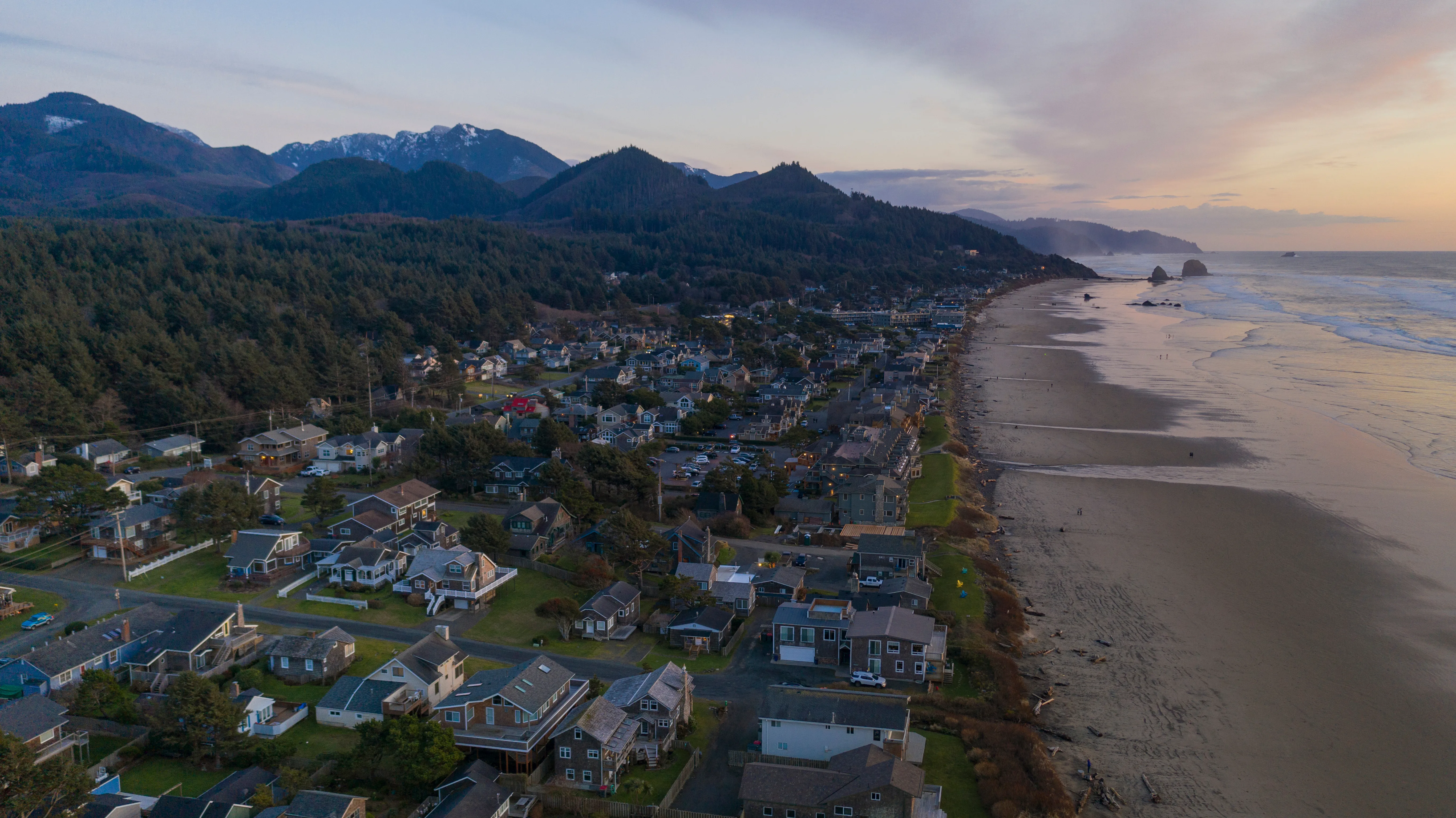
Cannon Beach is a market where location within the city genuinely shapes long-term value, and that matters when you're layering in down payment assistance. Homes in Tolovana Park and Downtown tend to hold value exceptionally well given their proximity to the beach and the town's core amenities. The North End and Ecola Creek areas have also attracted steady buyer interest, particularly from people looking for slightly quieter settings while staying close to everything. Desirable properties here — especially those priced under $750,000 — rarely sit long, and when something good hits the market, it can be gone within days.
That's exactly why talking with a lender before you start touring homes is so important, especially when down payment assistance is part of your plan. These programs add a layer of qualification and timing that needs to be sorted out in advance. Beyond that, your full monthly payment — which includes taxes, insurance, any HOA dues, and your loan structure — often looks quite different from what an online estimate suggests. We always work toward a budget that feels comfortable, not just the maximum you qualify for, so when the right Cannon Beach home appears, you're genuinely ready to move.
| Item | Amount |
|---|---|
| Purchase price | $340,000 (example) |
| Buyer's 1% down | $3,400 |
| Rocket's 2% grant | $6,800 — never repaid |
| Total down payment | $10,200 (3%) |
| Estimated closing costs | $6,500–$8,500 (varies by lender credits, title, county) |
| Buyer's estimated total cash to close | ~$9,900–$11,900 |
Cannon Beach is rated "not very competitive" by market metrics — homes average about 76 days to go pending, typically sell at roughly 5% below list price, and multiple-offer scenarios are uncommon. That's genuinely good news for a buyer using any form of DPA, because the seller pressure that can make grant-assisted offers difficult in hotter markets isn't a significant factor here. Sellers in Cannon Beach are generally open to longer timelines, and the slower pace of the market gives buyers room to negotiate.
The honest constraint isn't seller acceptance — it's inventory. A DPA buyer qualified for ONE+ is working with a purchase ceiling that doesn't reach a single active listing in Cannon Beach as of mid-2026. The town's entry-level inventory starts well above $450,000, and most of what sells trades between $700,000 and well over $1 million. For OHCS Cash Advantage buyers with a larger purchase budget, the competitive dynamics are manageable here — the market isn't fast enough to routinely favor clean-cash offers by a decisive margin. But DPA assistance on a $900,000 purchase still leaves a substantial cash requirement at close, and buyers should model that scenario carefully before assuming any single program covers the full gap.
The buyers for whom DPA programs work most cleanly in this region are those targeting neighboring markets. Seaside, roughly 10 miles north, has a median well below $400,000 and genuine ONE+-eligible inventory on the market at any given time. Astoria, about 35 miles north, offers similar price points with more variety. For buyers whose priority is the Cannon Beach lifestyle — the galleries on Hemlock Street, Haystack Rock at low tide, the quiet of Ecola Creek on a weekday morning — the honest guidance is to work with an OHCS Cash Advantage lender and model the full cost of entry at realistic Cannon Beach prices, rather than counting on a program built for a different price tier.
Local Expert Takeaway: For most buyers targeting Cannon Beach specifically, OHCS Cash Advantage is the realistic DPA path — ONE+'s $350,000 loan ceiling doesn't reach standard residential inventory in this market, but the state's deferred-second program can meaningfully reduce the cash-to-close on a $700,000–$900,000 purchase. If you're open to Seaside or Astoria as an alternative base with easy access to Cannon Beach, ONE+ becomes the clear first call — there's active inventory in that price range and the grant structure is cleaner than anything the state offers. Either way, start with a pre-approval conversation before narrowing your search, so the program limits don't surprise you mid-transaction.
Is there down payment assistance available in Cannon Beach, Oregon?
Yes, several programs apply to buyers in Cannon Beach. ONE+ by Rocket Mortgage offers a true grant of up to $7,000 with 1% down from the buyer, though its $350,000 loan ceiling is below current Cannon Beach market prices for standard residential homes. Oregon's OHCS Cash Advantage program covers higher purchase prices through a deferred second loan and is a more realistic fit for buyers shopping in Cannon Beach's actual price range.
What is the income limit for ONE+ in Clatsop County?
The ONE+ income limit in Clatsop County is tied to HUD's 80% Area Median Income figure, which currently sits at approximately $74,050 for the county. This limit applies regardless of household size for ONE+ qualification purposes. Buyers whose income exceeds that threshold can explore OHCS programs, which carry income limits ranging from roughly $98,000 to $138,000 depending on the specific track and household configuration.
What is the difference between ONE+ and OHCS DPA?
ONE+ is a true grant — Rocket Mortgage contributes 2% of the purchase price and that money is never repaid under any circumstances. OHCS Cash Advantage provides 4–5% of the loan amount as a deferred second mortgage with no monthly payment, but the assistance is repaid when the home is sold or refinanced. For buyers who qualify for both, ONE+ is the structurally cleaner option; for buyers whose purchase price exceeds the ONE+ ceiling, OHCS is the practical path forward.
Explore the full Cannon Beach series: The Ultimate Cannon Beach Relocation Guide · Is Cannon Beach Safe? · Cost of Living in Cannon Beach · Best Neighborhoods in Cannon Beach · Cannon Beach Schools & Family Life · Cannon Beach Youth Sports · Cannon Beach Parks & Recreation · Retiring in Cannon Beach · 1031 Tax-Deferred Exchange in Cannon Beach · Cannon Beach First-Time Homebuyers Guide · Cannon Beach Down Payment Assistance Guide · Moving to Cannon Beach from California
Check Out the Oregon Coast Rankings: Oregon Coast Cost of Living — All 16 Cities Ranked · Best Places to Retire on the Oregon Coast · Best Oregon Coast Cities for Families · Best Oregon Coast Cities for Remote Workers · Oregon Coast Real Estate Market Report 2026 · Oregon Coast vs. Washington Coast