
Central Oregon · Oregon
Retiring in La Pine: Is It the Right Fit for Your Next Chapter? (2026)
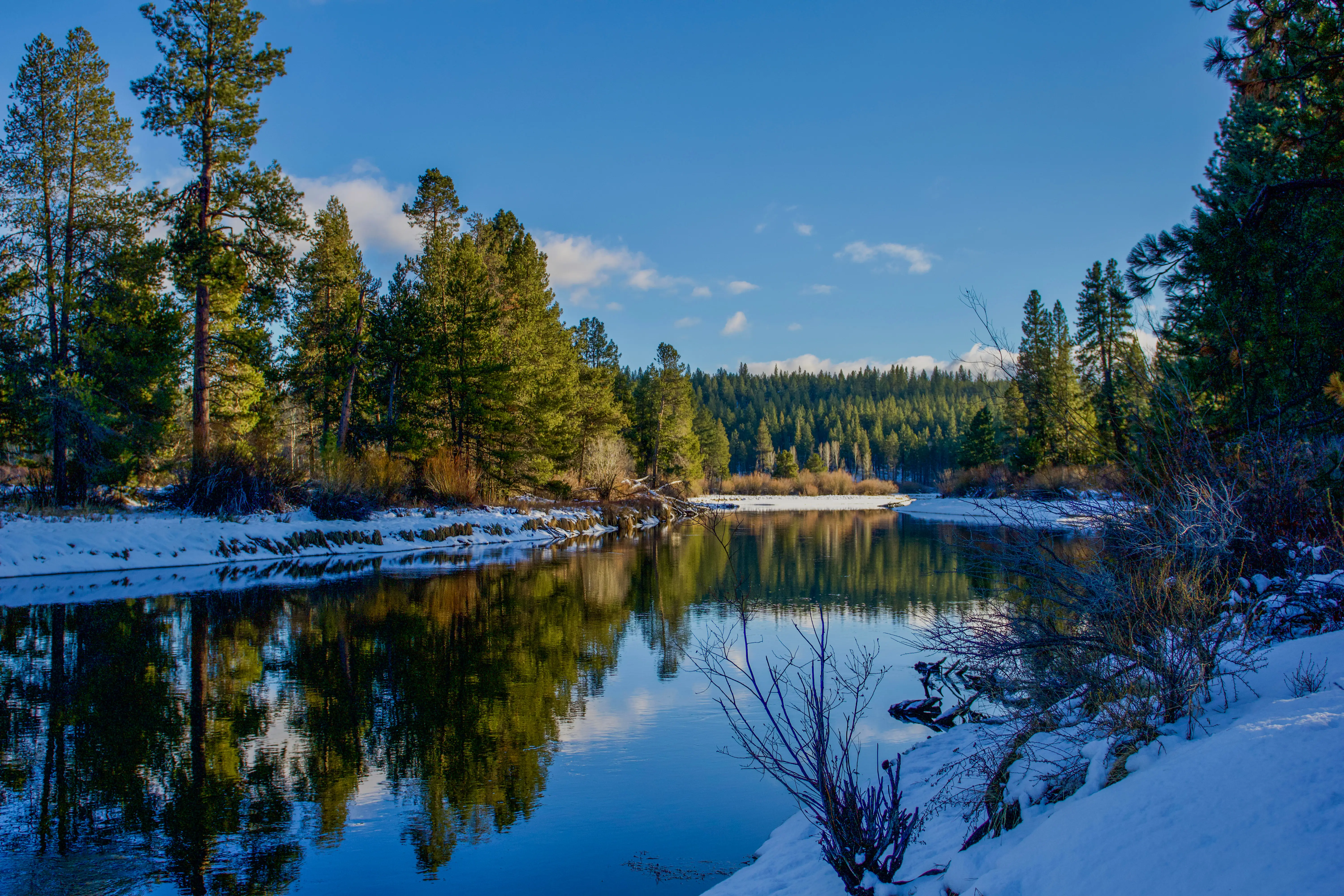
La Pine doesn't try to be a retirement destination. It simply is one — quietly, organically, without the golf courses and gated communities that usually signal "retiree town." More than a quarter of La Pine's roughly 2,600 residents are 65 or older, the median age hovers around 45, and fewer than a quarter of households have kids under 18. The math tells the story before you even visit: this is a community that has drawn people who are done with the hustle and ready for something slower, quieter, and surrounded by ponderosa forest.
The retiree who thrives in La Pine is specific. You love the outdoors not as an occasional hobby but as a daily orientation — morning walks through Deschutes National Forest, afternoons on the Little Deschutes River, weekend drives to Newberry National Volcanic Monument. You've made peace with driving 30-plus minutes to a full hospital, and you'd rather have a $380,000 home on a half-acre than a $600,000 condo near a medical district. You don't need a theater district. You need clean air, dark skies, and a community that knows your name.
This guide covers the full retirement picture for La Pine: the Oregon tax environment, healthcare realities, senior living options, what daily life actually looks like without a car, how La Pine stacks up against other Central Oregon retirement destinations, and which neighborhoods tend to draw retirees who stay for decades.

| Income Type | Oregon Tax Treatment |
|---|---|
| Social Security Benefits | Not taxed by Oregon |
| Public Pension (federal, state, local) | Taxed as ordinary income; Oregon Pension Income Credit may apply |
| Private Pension / IRA / 401(k) Distributions | Taxed as ordinary income at 4.75%–9.9% |
| Investment Income (dividends, capital gains) | Taxed as ordinary income |
| Wages / Self-Employment | Taxed as ordinary income |
| Property Tax (La Pine rate) | Approximately 0.59% of assessed value |
| Oregon Estate Tax | Applies to estates over $1 million |
| Sales Tax | None — Oregon has no sales tax |
Oregon's income tax structure is the headline challenge for retirees drawing from IRAs or private pensions. The top marginal rate of 9.9% kicks in at relatively modest income levels compared to states like Washington or Nevada, and distributions from 401(k) accounts are fully taxable as ordinary income. Social Security escaping Oregon taxation is a meaningful benefit for retirees whose income is weighted toward that source, but if you're pulling $60,000 per year from a traditional IRA, Oregon will take a noticeable share.
The offset that many La Pine retirees underutilize is Oregon's Property Tax Deferral Program for seniors. Homeowners 62 and older who meet income thresholds can defer property taxes as a lien against the home rather than paying annually — a program that can meaningfully improve cash flow for retirees on fixed income. With La Pine's property tax rate sitting at approximately 0.59%, annual taxes on a $380,000 home run roughly $2,242 — one of the lowest effective burdens in Oregon. For retirees comparing Washington (no income tax, higher property taxes) against La Pine, the calculus depends heavily on pension and investment income levels. Washington wins for high-income retirees drawing from private accounts; Oregon wins for Social Security-dominant retirees who own modest homes.
La Pine's healthcare infrastructure has improved significantly in recent years, but retirees need to enter this decision clear-eyed about one material fact: there is no hospital or emergency room in La Pine. When something serious happens, you are 35 miles from St. Charles Medical Center in Bend — the only Level II Trauma Center east of the Cascades, with 226 beds and nationally recognized vascular and spine surgery programs. The La Pine Rural Fire Protection District operates an advanced life support ambulance service with two vehicles specifically for these transfers, but the drive takes time, and that's a real consideration for anyone managing cardiac, stroke, or fall risk.
For day-to-day and preventive care, La Pine is better served than its size suggests. La Pine Community Health Center — a nonprofit federally qualified health center — offers primary care, women's health, dental, behavioral health, and pediatrics from a modern 27,000-square-foot facility. A $16 million wellness expansion is in the final stages of development that will add diagnostic imaging including mammography and a substantially expanded mental and behavioral health program. MacKenzie Scott's $1.6 million donation helped fund this project, which is projected to open in 2026. The St. Charles system also operates an urgent care clinic in La Pine with current wait times posted online, and the St. Charles Family Care Clinic at 51781 Huntington Road provides additional access for established patients.
For retirees managing multiple chronic conditions or requiring regular specialist visits — cardiology, oncology, neurology — the practical model here is building relationships with Bend-based specialists and treating the 34-minute drive as routine. Retirees who've lived in rural Oregon before generally adapt without issue. Those relocating from urban areas with hospital campuses two miles away should think carefully about whether this trade-off is sustainable long-term.
La Pine's formal senior living market is small but anchored by two well-regarded local communities. Prairie House Assisted Living and Memory Care, at 51485 Morson Street, is the primary assisted living option within La Pine proper — licensed for up to 49 residents in its assisted living component and 18 in its dedicated memory care wing. The community offers scheduled transportation, a gaming room, and multiple floor plan configurations. For retirees needing memory care support, Prairie House's on-site program means staying in the La Pine community rather than relocating to Bend.
Little Deschutes Lodge Retirement Center serves as the other cornerstone of in-town senior living and occupies a distinct position in the community — it was pursuing LEED Platinum certification east of the Cascades and functions as something closer to a social hub for La Pine seniors than a traditional retirement campus. For retirees who want independent living with community connection built in, the Lodge is worth a visit early in your research process.
For those requiring more intensive care or a larger campus with more amenity depth, Bend's senior living market is the realistic next tier. Stone Lodge, Prestige Senior Living High Desert, and Cascades of Bend are among the higher-rated independent and assisted living communities in the region, all reachable within 40 minutes of La Pine.
| Community | Type | Location | Est. Monthly Cost |
|---|---|---|---|
| Prairie House Assisted Living | Assisted Living | La Pine (51485 Morson St.) | $3,500–$5,500 |
| Prairie House Memory Care | Memory Care | La Pine (51485 Morson St.) | $5,000–$7,000 |
| Little Deschutes Lodge | Independent/Retirement | La Pine | $2,200–$3,500 |
| Barbara McVay Adult Foster Home | Adult Foster Care | La Pine | $2,500–$4,000 |
| Stone Lodge | Independent/Assisted | Bend area | $3,000–$5,000 |
| Prestige Senior Living High Desert | Assisted Living | Bend area | $3,500–$5,500 |
| Cascades of Bend | Independent/Assisted | Bend area | $3,200–$5,200 |
Looking to buy in La Pine? Estimate your payment.
Enter your numbers to see an estimated monthly mortgage payment.
Estimate only. Excludes HOA fees and mortgage insurance.
The first thing to understand about daily life in La Pine is that a car is not optional — it is foundational. There is no meaningful public transit serving La Pine, no walkable commercial core where you could manage groceries, pharmacy, and lunch without driving. The town's layout is spread across residential neighborhoods threaded through ponderosa forest, with services concentrated along Highway 97 and the Huntington Road corridor. If you or your partner anticipates a future without driving, La Pine requires a support plan: family nearby, community transportation through the senior center, or a long-term willingness to relocate as mobility changes.
What La Pine does offer on foot and by short drive is something most retirement towns can't replicate: immediate, front-door access to trails. Residents in neighborhoods like Ponderosa Pines and River Pine Estates can walk directly into Deschutes National Forest from their property edges. The trail network connecting La Pine State Recreation Area, the Little Deschutes River corridor, and surrounding forest is extensive enough that outdoor-focused retirees report logging miles daily without repeating the same route.
The La Pine Senior Activity Center at 16450 Victory Way is the social spine of retirement life here. Open to anyone 60 and up, the center runs bingo nights, dinner dances, quilting groups, painting classes, and line dancing on a rotating weekly calendar. Lunch is served Tuesday through Thursday with a suggested donation of $5 for members, and annual membership runs $40 — a remarkably low bar for staying connected. The center was founded in 2010 and has grown steadily as La Pine's senior population has expanded; it serves not just La Pine proper but residents across southern Deschutes and northern Klamath counties.
Cultural programming beyond the senior center is honest about its limits. La Pine doesn't have a performing arts venue, a downtown gallery district, or a restaurant scene that rivals Bend's. What it has are community traditions — the La Pine Frontier Days celebration in summer, seasonal events through the recreation district, and the kind of informal social fabric that forms when a small community has a high proportion of long-term residents. Retirees who describe themselves as "not big going-out people" consistently find enough. Those who want a theater subscription and a rotating roster of new restaurants should put Bend on their primary list and La Pine on their secondary.
For errands, the primary grocery options are along the Highway 97 corridor in La Pine, with Fred Meyer in Bend serving as the go-to for larger shopping runs. The pharmacy situation has improved with the LCHC expansion, and St. Charles urgent care's presence means minor medical needs don't require the full Bend drive. One thing that surprises most people after six months of living here: the number of neighbors who become genuine community — people who check on each other, share equipment, coordinate rides. La Pine's small scale accelerates the kind of neighborly reciprocity that larger towns have lost.
| City | Median Home Price | Nearest Full Hospital | Walkability | Senior Depth | Overall Retirement Fit |
|---|---|---|---|---|---|
| La Pine | $380,000 | St. Charles Bend (35 mi) | Low — car required | Strong — 25%+ seniors | Best for outdoor-focused, budget-conscious retirees |
| Bend | $650,000–$700,000 | St. Charles Bend (on-site) | Moderate–High in west side | Good — large senior market | Best all-around; higher entry cost |
| Sunriver | $600,000–$800,000 | St. Charles Bend (28 mi) | Moderate (resort paths) | Moderate — resort/vacation mix | Best for amenity-focused resort living |
| Redmond | $430,000–$480,000 | St. Charles Redmond | Moderate | Good — growing senior base | Best for budget Bend alternative with closer hospital |
| Sisters | $550,000–$650,000 | St. Charles Bend (38 mi) | Low–Moderate | Moderate — small town | Best for small-town charm with arts access |
| Gilchrist | Under $250,000 | St. Charles Bend (45 mi) | Very Low | Very Limited | Best for extreme budget; very limited services |
The comparison that comes up most often in La Pine retirement conversations is La Pine versus Redmond. Redmond offers a slightly larger commercial base, a St. Charles campus with urgent care and growing services, and a more central location in the Bend-Redmond metropolitan orbit. La Pine wins on price, on forest access, and on the specific quality of quiet that comes from being at the edge of the developed region rather than inside it. Retirees with cardiac or mobility concerns often land in Redmond; retirees prioritizing natural setting and housing value tend to choose La Pine.
The comparison with Sunriver is worth a separate paragraph because they sit 15 minutes apart. Sunriver's resort infrastructure — miles of paved paths, a marina, resort pools, golf — appeals to retirees who want structured amenity access. But Sunriver's pricing reflects that premium, and the community skews heavily toward vacation ownership rather than permanent residency, which changes the social texture. La Pine's permanent resident culture is more cohesive, more community-oriented, and considerably more affordable.
Antelope Meadows draws retirees who want a bit more space between neighbors without going fully rural. Lots here tend to run generous, homes sit back from quiet residential streets, and the neighborhood has attracted a stable long-term resident base. The forest buffer on multiple edges keeps the setting peaceful year-round.
Best for: Retirees who want neighborhood community feel with room to breathe and no HOA pressure.
River Pine Estates positions you close to the Little Deschutes River corridor, which means morning walks along water are a realistic daily option rather than a special occasion. Properties here blend the seclusion of rural Central Oregon with enough proximity to La Pine's service corridor to avoid feeling isolated.
Best for: Retirees who prioritize natural setting and easy trail access over proximity to services.
Pine Crest is one of La Pine's more established residential areas, with a range of home vintages and price points that give buyers flexibility. The neighborhood's layout tends to be accessible and relatively flat compared to some hillier areas, which matters more with each passing year for retirees thinking ahead about mobility.
Best for: Retirees who want an established neighborhood with varied housing stock and manageable terrain.
Ponderosa Pines earns its name — the forest canopy here is the real thing, and homes on certain streets have direct access to trail systems that connect into the national forest. The trade-off is occasional wildfire smoke season awareness, which any Central Oregon buyer should factor in regardless of neighborhood.
Best for: Outdoor-focused retirees for whom living adjacent to forest land is non-negotiable.
The eastern extension of Ponderosa Pines carries much of the same character — forested lots, quiet streets, ponderosa canopy — with slightly different positioning relative to La Pine's commercial spine. Homes here tend to offer strong value in the La Pine context.
Best for: Retirees who want the Ponderosa Pines setting with slightly easier access to Highway 97 services.
Sunrise Boulevard functions as something of a backbone corridor for residential La Pine, with neighborhoods and access roads branching from it into the surrounding forest. Properties along and near Sunrise offer a balance of connectivity and quiet, with the senior center and primary services within a short drive.
Best for: Retirees who want central positioning within La Pine without being directly on the highway.
Central La Pine puts you closest to the service corridor — the LCHC clinic, St. Charles urgent care, the senior activity center on Victory Way, grocery options along Highway 97. For retirees who want to minimize drive time for daily errands or who anticipate scaling back driving in coming years, this positioning matters.
Best for: Retirees prioritizing service access and shorter drives for daily needs.
Tall Pines lives up to its name with the kind of mature tree coverage that La Pine buyers come specifically to find. The neighborhood sits in the quieter residential fabric away from through-traffic corridors, with a settled feel that attracts long-term owners.
Best for: Retirees who want maximum quiet and canopy coverage in a true neighborhood setting.

Local Expert Takeaway: Retirees who thrive in La Pine tend to be active, self-sufficient, and genuinely excited about the outdoors as a lifestyle rather than a weekend activity. If that's you, neighborhoods like River Pine Estates and Ponderosa Pines will feel like exactly the right fit at a price point that lets you retire without financial strain. If you need walkable services, regular specialist access, or a robust cultural calendar, Bend's west side or Redmond will serve you better — La Pine works best as a primary choice made with eyes open, not a consolation prize for buyers priced out of somewhere else.
Is La Pine a good place to retire?
La Pine suits a specific retiree profile very well: outdoor-active, budget-conscious, comfortable with rural trade-offs, and not dependent on urban amenities. With over a quarter of residents aged 65-plus and a median home price around $380,000, it offers genuine community and extraordinary natural access at a price that makes financial sense for most fixed-income retirements.
What healthcare is available in La Pine for seniors?
La Pine Community Health Center provides primary care, dental, behavioral health, and women's health from a modern facility, with a major wellness expansion opening in 2026 that will add diagnostic imaging. St. Charles urgent care handles non-emergency acute needs. For hospital-level care, St. Charles Medical Center in Bend — the only Level II Trauma Center east of the Cascades — is approximately 35 miles away.
How does La Pine compare to Bend for retirement?
Bend offers better hospital access, more walkable neighborhoods, a larger senior living market, and a richer cultural calendar — but the median home price runs $270,000–$320,000 higher than La Pine's. Retirees who want hospital proximity and urban amenities choose Bend; retirees who want forest living, lower taxes, and a quieter pace at a substantially lower entry cost choose La Pine. Many retirees land in La Pine specifically because a Bend home sale funds the purchase outright.
Explore the full La Pine series: The Ultimate La Pine Relocation Guide · Is La Pine Safe? · Cost of Living in La Pine · Best Neighborhoods in La Pine · La Pine Schools & Family Life · La Pine Youth Sports · La Pine Parks & Recreation · Retiring in La Pine · 1031 Tax-Deferred Exchange in La Pine · La Pine First-Time Homebuyers Guide · Moving to La Pine from California
Tell us what you need help with and we'll connect you with local resources.

About the Author
Todd Davidson is the founder of Living in Oregon and Living in Washington, where he publishes in-depth city guides, neighborhood resources, and local market insights covering more than 180 communities across the Pacific Northwest. While his background is in home financing and real estate, he created these digital platforms to help families research and compare regions before making a move.